

Jason Smith is a trusted water heater repair specialist based in Lakewood, California. He specializes in diagnosing, repairing and replacing tank and tankless water heaters from leading brands.
Roughly 18% of a residential property’s energy consumption comes from water heating — making it one of the most critical systems a landlord manages. When a unit fails in a rental property, the clock starts immediately: California law requires landlords to maintain habitable conditions, and that includes reliable hot water. This water heater replacement checklist for landlords is designed to help Lakewood property owners and managers move through the process efficiently, legally, and without costly missteps.
Key Takeaways
- California law classifies hot water as a habitability requirement — prompt replacement is a legal obligation, not just good practice.
- Tank water heaters typically last 8–12 years; tankless models can last up to 20 years with proper maintenance.
- Always pull a permit for water heater replacement in Lakewood — unpermitted work can create liability and complicate property sales.
- Capacity planning matters: undersized units lead to tenant complaints and accelerated wear.
- Tankless water heaters offer long-term savings but require higher upfront investment and specific venting.
- Notify tenants before scheduling replacement work — California requires reasonable notice (generally 24 hours minimum).
- Document everything: warranties, permits, and service records protect landlords in disputes.
- Same-day replacement services are available in Lakewood for urgent situations.
Why Does This Checklist Matter for Rental Property Owners?
A water heater failure in a rental unit is not just an inconvenience — it is a legal and financial exposure. California Civil Code Section 1941 obligates landlords to maintain rental units in a habitable condition, which explicitly includes functioning hot water at a minimum temperature of 110°F (with 120°F recommended for safety and efficiency). Failure to act promptly can expose landlords to rent withholding, repair-and-deduct remedies, or legal action.
Beyond legal compliance, a well-executed replacement protects the property’s value, reduces emergency call-out costs, and maintains tenant satisfaction. Using a structured water heater replacement checklist for landlords ensures nothing falls through the cracks — from initial assessment to final documentation.
How Do You Know When Replacement Is Necessary?
Not every water heater problem requires full replacement. However, several clear indicators point toward replacement over repair.
Signs that replacement is the right call:
- The unit is more than 10 years old (tank-style) or showing persistent performance decline
- Rust-colored water or visible corrosion on the tank body or connections
- Rumbling or popping sounds caused by sediment buildup
- Repeated pilot light failures on gas units
- A leaking tank — this is never repairable and always requires immediate replacement
- Rising energy bills without a change in usage patterns
For a detailed breakdown of when repair makes more sense than replacement, see our guide on water heater repair vs. replacement.
What Should Be on a Landlord’s Pre-Replacement Checklist?
Before scheduling a replacement, landlords should complete a pre-replacement assessment. Skipping these steps leads to wrong-sized units, code violations, and unnecessary delays.
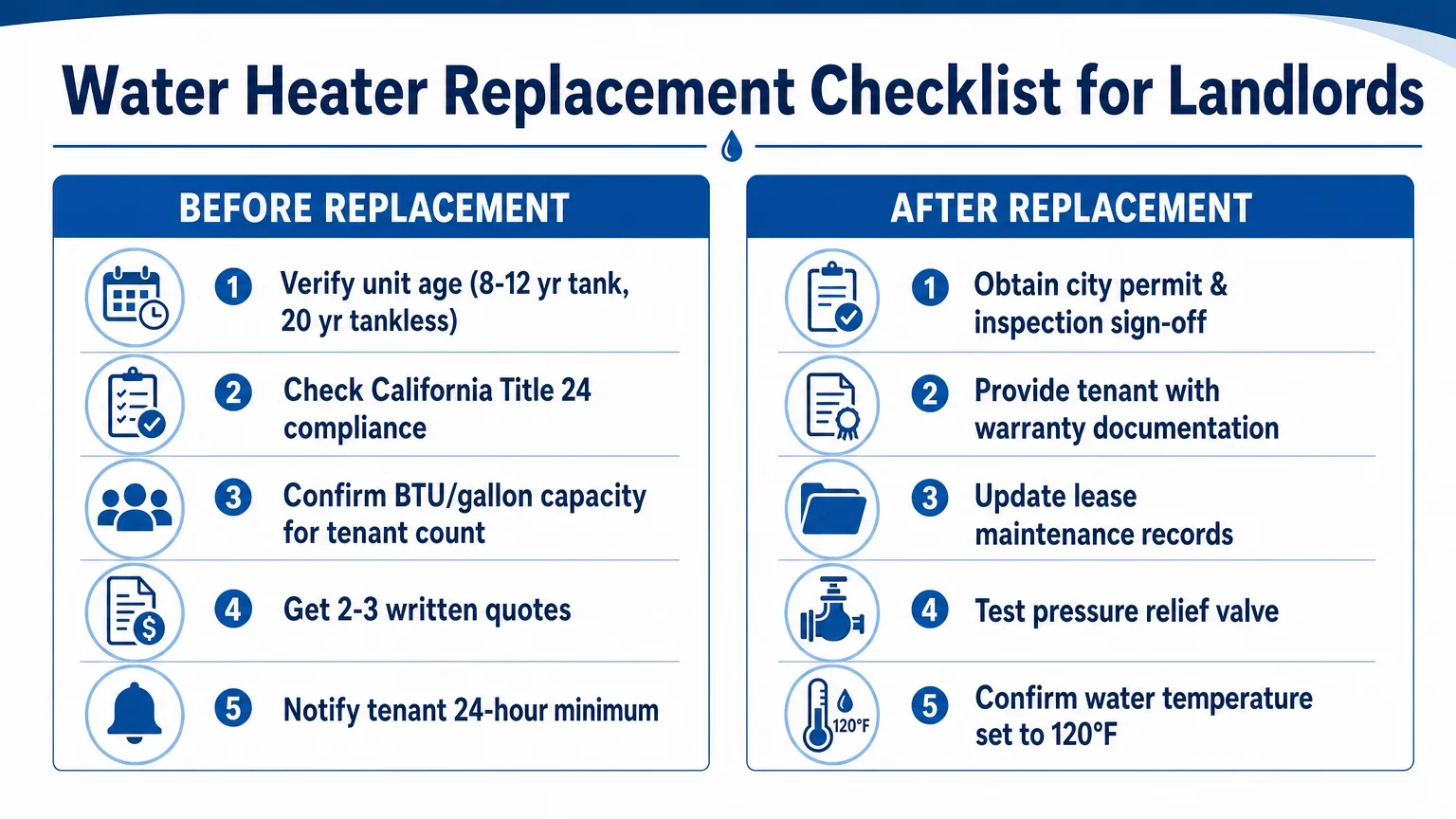
Pre-Replacement Checklist:
| Step | Action Required | Notes |
|---|---|---|
| 1 | Confirm unit age and service history | Check installation date on the label |
| 2 | Assess current capacity vs. tenant count | 40 gal for 1-2 occupants; 50+ gal for 3-4 |
| 3 | Identify fuel type (gas or electric) | Affects cost, venting, and permit requirements |
| 4 | Check California Title 24 energy compliance | New units must meet current efficiency standards |
| 5 | Obtain 2-3 written quotes | Compare unit cost, labor, and permit fees |
| 6 | Notify tenant in writing | Minimum 24-hour notice for non-emergency entry |
| 7 | Confirm permit requirements with local authority | Lakewood falls under LA County jurisdiction |
| 8 | Verify access and workspace clearance | Technician needs adequate space for safe installation |
For landlords in the Bellflower area managing multiple units, residential water heater solutions in Bellflower covers additional regional considerations.
Tank vs. Tankless: Which Is the Right Choice for a Rental Property?
This is one of the most consequential decisions a landlord makes during replacement. Both options are viable — the right choice depends on the property type, tenant profile, and long-term investment horizon.
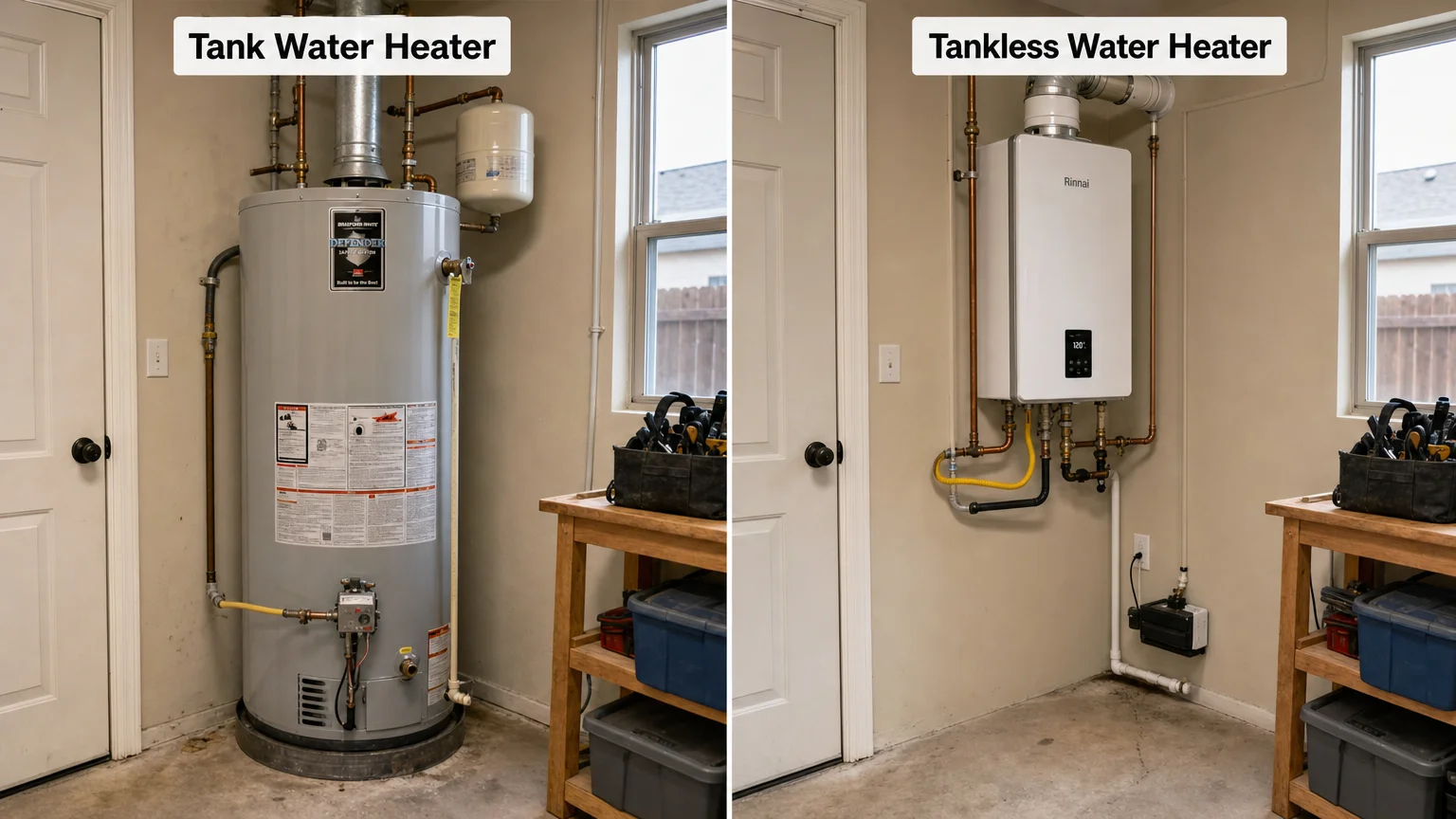
Tank Water Heaters
- Lower upfront cost (typically more accessible for single-unit landlords)
- Simpler installation in most existing utility spaces
- Shorter lifespan (8–12 years average)
- Higher standby energy loss
- Familiar technology — easier for most technicians to service
Tankless Water Heaters
- Higher upfront cost, but significantly longer lifespan (up to 20 years)
- On-demand heating eliminates standby energy loss
- Requires updated gas lines or electrical capacity in some properties
- Smaller physical footprint — valuable in compact utility spaces
- Strong appeal for tenant retention in higher-end rentals
For landlords managing properties in Lakewood who want to explore the long-term economics of going tankless, tankless water heater installation provides a full breakdown of what the process involves. Landlords in Bellflower can also review tankless water heater installation in Bellflower for area-specific guidance.
If the existing unit is a gas model, gas water heater replacement in Lakewood covers the specific requirements for that fuel type, including venting and seismic strapping standards required in California.
What Permits and Inspections Are Required in Lakewood, CA?
Water heater replacement in Lakewood requires a permit through the Los Angeles County Building and Safety department. This is non-negotiable — and it is the landlord’s responsibility to ensure the work is permitted, regardless of which contractor performs the installation.
Why permits matter for landlords specifically:
- Unpermitted work can void homeowner’s insurance coverage
- Permit records protect landlords if a tenant files a habitability complaint
- Inspections confirm the installation meets current seismic strapping requirements (mandatory in California)
- Permit history is reviewed during property sales and can affect appraisals
A qualified technician will typically pull the permit on the landlord’s behalf and schedule the inspection. Always request a copy of the permit and the final inspection sign-off for your property records.
What Capacity Does a Rental Unit Actually Need?
Undersizing a water heater is a common and costly mistake in rental properties. A unit that cannot meet peak demand generates tenant complaints, accelerates wear on the heating element or burner, and often leads to a second replacement within a few years.
General capacity guidelines (tank-style):
| Occupants | Recommended Tank Size |
|---|---|
| 1–2 | 30–40 gallons |
| 3–4 | 40–50 gallons |
| 5+ | 50–80 gallons |
For electric water heater replacements, capacity and recovery rate are both important — a larger tank with a slow recovery rate can still leave tenants without hot water during peak morning hours. For detailed guidance on electric unit selection, see electric water heater replacement.
What Post-Installation Steps Should Landlords Complete?
The replacement is not complete when the technician leaves. A thorough post-installation process protects the landlord legally and ensures the system performs as expected.
Post-Installation Checklist:
- Obtain and file the permit and inspection sign-off
- Record the new unit’s model number, serial number, and installation date
- Set water temperature to 120°F (balances safety and efficiency)
- Test the pressure relief valve (T&P valve) to confirm it operates correctly
- Provide tenant with basic operating instructions and emergency shutoff location
- Update the lease or property maintenance log with service records
- Register the unit’s warranty with the manufacturer
- Schedule a follow-up inspection at 6 months if the property has hard water (common in LA County)
Landlords managing properties across multiple cities — including Cerritos, Norwalk, or Hawaiian Gardens — should maintain a separate service record for each property. For Cerritos-area properties, water heater installation in Cerritos and water heater installation in Hawaiian Gardens offer location-specific installation information.
Ready to Move Forward With Your Rental Property’s Water Heater Replacement?
A well-executed water heater replacement protects your tenants, your property, and your investment. Whether the unit has failed unexpectedly or you are planning a proactive upgrade before the next lease renewal, working with experienced local professionals makes the process straightforward.
Water Heater Repair Lakewood connects landlords and property managers throughout Lakewood, Bellflower, Cerritos, Norwalk, and surrounding communities with qualified technicians who understand California’s compliance requirements and the specific demands of rental property work. Same-day appointments are available for urgent situations, and transparent pricing means no surprises on the final invoice.
Contact Water Heater Repair Lakewood today to discuss your property’s needs and get a clear, written quote.
Frequently Asked Questions
How quickly must a landlord replace a failed water heater in California?
California law does not specify an exact number of hours, but courts have generally interpreted "reasonable time" as 24–72 hours for essential services like hot water. For rental units, acting within 24 hours is the professional standard and reduces legal exposure significantly.
Does a landlord need to notify a tenant before replacing a water heater?
Yes. California Civil Code Section 1954 requires landlords to provide at least 24 hours' written notice before entering a rental unit for non-emergency repairs. Emergency replacements (e.g., an actively leaking tank) allow for shorter notice, but written documentation of the emergency is still advisable.
Can a tenant deduct repair costs from rent if a landlord delays water heater replacement?
Under California's repair-and-deduct remedy, tenants may hire a contractor and deduct up to one month's rent from the next payment if the landlord fails to address a habitability issue within a reasonable time after written notice. This makes prompt action essential.
What is the average lifespan of a water heater in a rental property?
Tank water heaters in rental properties typically last 8–12 years, though heavy use and hard water (common in the Lakewood area) can shorten that to 7–9 years. Tankless units generally last 15–20 years with annual maintenance.
Is a permit always required for water heater replacement in Lakewood?
Yes. The Los Angeles County Building and Safety department requires a permit for all water heater replacements, including like-for-like swaps. A qualified technician will pull the permit as part of the installation process.
What is the cost difference between tank and tankless water heaters for rental properties?
Tank water heater replacement in Lakewood typically ranges from $900–$1,800 installed, depending on unit size and fuel type. Tankless installations generally run $1,800–$3,500 or more, depending on gas line upgrades and venting requirements. The higher upfront cost of tankless units is often offset by longer lifespan and lower operating costs.
Should landlords buy the water heater themselves or let the contractor supply it?
Letting the contractor supply the unit is generally recommended. Contractors source units at trade pricing, stand behind the equipment they install, and can coordinate warranty registration. Landlords who supply their own units may find contractors unwilling to warranty labor if the unit itself is the source of a problem.
What fuel type is better for a rental property — gas or electric?
Gas water heaters heat water faster and typically cost less to operate in California, where natural gas rates are generally lower than electricity on a per-BTU basis. However, electric units are simpler to install in properties without existing gas service. The right choice depends on the property's existing infrastructure.
Jason Smith is a trusted water heater repair specialist based in Lakewood, California. He specializes in diagnosing, repairing and replacing tank and tankless water heaters from leading brands.